NP46AG Lint Traps
Application
Commercial laundromats and on-premises laundries running machine banks of three to five or more units
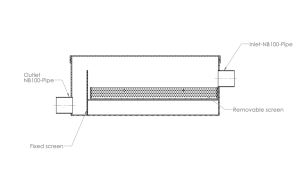
The NP46AG is the larger trap in the Viking lint trap range, built for laundries where several machines drain into a common manifold. Lint is captured horizontally on a removable stainless steel screen, backed by a fixed vertical screen, and the unit includes an overflow mechanism in the event the screens block.
As a rule of thumb, allow one trap per machine bank of up to five units. Where machines are spread across a site, it is often better to group them and provide a trap for each group rather than run long drain lines back to a single unit. Additional NP46AG units can be added as machine numbers grow, and Viking can supply a dual manifold to connect them.
Fabricated in Australia from polypropylene, with materials selected to withstand commercial laundry discharge temperatures.
Specifications
| Model / part no. | NP46AG |
|---|---|
| Machine capacity | 3–5+ units. Increase the quantity of NP46AG units for more machines |
| Dimensions (W x D x H) | 1000 x 300 x 400 mm |
| Weight | 26 kg |
| Inlet / outlet | NB 100 pipe, with a dual manifold available — inlet and outlet heights can be customised |
| Lint filter / collection | Removable stainless steel lint screen positioned horizontally in the flow, plus a fixed vertical screen |
| Material | Polypropylene tank, stainless steel screens |
| Maintenance interval | Per conditions and load profile. Weekly check recommended; empty two to three times a week, or when full |
| Warranty | 10-year manufacturing warranty |
Tank capacity in litres is not stated because capacity alone does not determine the appropriate lint trap. Selection should account for the expected peak discharge flow, lint-screen or filter capacity, and the applicable water authority’s sizing and approval requirements.
Heavy-duty installations can see wash temperatures of 71–85°C where linen is being disinfected. Where discharge exceeds the authority limit — 38°C for Sydney Water — an averaging and cooling pit should be installed ahead of the connection to sewer.
Technical Drawings
The technical drawing is the one to submit with your trade waste application. The 2D section and 3D view show the inlet, outlet and screen arrangement at a glance.
Technical Drawing 2D Section View 3D View
How It Works
- Collect — wastewater from the machine bank flows into the lint trap tank via the inlet connection.
- Filter — flow velocity reduces and lint fibres are captured on the horizontal stainless steel screen and the fixed vertical screen behind it.
- Discharge — cleaned water passes through and exits via the outlet to the sewer connection.
- Maintain — Inspect the removable screen regularly. Before it becomes full, lift it out, empty the captured lint into an appropriate bin, clean the screen as directed and secure it back in place. Clean the fixed screen whenever excess lint is visible.
Hot tip: Check more frequently in the first few weeks after installation to see how quickly lint accumulates. These observations can be used to set a cleaning schedule, subject to the manufacturer’s instructions and your trade-waste permit.
Note that the trap carries two screens. The removable horizontal screen lifts out for cleaning; the vertical screen is fixed and is cleaned in place.
Maintenance
- Weekly visual inspection is recommended for busy sites.
- Empty when the screen reaches roughly two thirds full, to avoid overflow or reduced performance. Frequency depends on machine count and usage.
- Rinse the screen thoroughly with a hose after emptying. Inspect the mesh for damage or clogging and replace if needed.
- Clean all screens, fixed and removable, when excess signs of lint are present.
- Sediment collecting in the bottom of the tank should be cleaned out during service, not flushed through.
- Keep a simple log of date and quantity emptied. It helps predict service intervals and demonstrates due diligence to the authority.
- Spare screens are available from Viking for minimal downtime during cleaning.
- Extra provisions are taken in heavy duty industrial and mine site applications. Talk to the Viking technical team.
Installation
- Position the trap for easy, frequent access to remove and empty the screen — plant room, under counter or external.
- Allow one trap per machine bank of up to five units. Group machines and provide a trap per group to cater for the required fall.
- Provide adequate pipe fall and ventilation in accordance with AS/NZS 3500 and local plumbing codes.
- Inlet connection comes from the machine drain manifold; the outlet goes to sewer, and may require a P-trap or one-way valve depending on code.
- For below-ground installations, Viking can supply suitable trafficable or light-duty covers and risers.
- Custom manifolds are available to connect multiple lint trap units.
- Custom-sized Paneltim® plinths are available to elevate machines, create fall, and leave space for electrical and piping.
- Always obtain prior trade waste approval from your local water authority. This is critical for laundromats.
- Viking supplies full technical drawings for the NP46AG to assist with authority submissions. Download the drawings.
Trade Waste Compliance
Commercial laundromats are high risk for lint-related sewer blockages and ‘lintbergs’. Many water authorities, including Sydney Water, require pre-treatment such as a lint trap or screen before discharge to sewer.
Water authority requirements for lint arrestors generally call for:
- a fixed screen, or a fail-safe cut-off mechanism, robust enough to prevent removal, intentional damage or bypass;
- a removable basket supplied for use in conjunction with that fixed screen or cut-off mechanism;
- a handle or other grip on the removable basket to allow easy removal;
- an aperture size no greater than 4 mm for both the removable basket and the fixed screen;
- materials that withstand high temperature and extreme ranges of pH.
Requirements vary between authorities and change over time. Confirm the current standard with your local water authority before submitting.
Related Products
NP44AG Lint Trap — the compact model, for up to three machines.
Lint Trap Sizing Guide — compare models against machine count, temperature and load profile.
Averaging & Cooling Pits — where discharge temperature exceeds the authority limit.
Hair Trap — for hairdressing salons and dog wash bays.
Contact Viking Plastics today for custom solutions and Australia-wide delivery. For further information you can request a quote, or call Viking Plastics on 1800 143 143.
Viking Plastics Lint Traps are an Australian Made Product